Tearing Down the Walls

In a speech marking the first year of his administration, President Donald Trump reemphasized a message he communicated many times during his campaign: that “open borders” promote the proliferation of drugs, weapons, and gangs. As distasteful as that message is, he might be right. Central America serves as a chokepoint for much of the drugs manufactured in the south. The region’s unique geography focuses the intense violence and vast sums of money required to control the drug trade and aims it squarely at markets in the United States. With many governments in the region still developing after the upheavals of the Cold War, Central America’s political geography is just as important as the physical. Corruption, poverty, and weak institutions provide the fertilizer for growth of the ultimate symptom of the regional disease: organized crime gangs known locally as “Maras.”

For Trump and his supporters, construction of a border wall seems like a common sense defense but the problem is more complex than bad people that want to cross the border. The Maras represent only one aspect of a complex regional problem that doesn’t lend itself to national solutions and certainly not to simple ones. So much so that President Trump’s politicization of border security reveals the weaknesses in his simplistic and unilateral solution: success requires the cooperation and assistance of regional partners. In some cases, these are countries the President recently referred to in derogatory terms. The subsequent cacophony of protests from around the world and the resignation of at least one US Ambassador (Ambassador John Feeley in Panama) indicate President Trump’s approach may enjoy limited success.

Highway to the USA

The Central American corridor has long been a direct path to the United States for gangs like the Maras. In the 1980s, they emerged in poor neighborhoods in Los Angeles, California. At that time, many Central American countries, particularly Guatemala and El Salvador, were suffering violent civil wars that displaced thousands of people to American cities. The traumatized and largely uneducated victims of those wars found shelter for their fragile new lives in poor expatriate communities there but it was not perfect; the perpetrators understood the utility of violence and organization and they lived among their victims in America.

When peace began to take hold in Central America in the 1990s, many of the combatant “guerilla” groups demobilized, expecting to inherit a place in peaceful societies that respect human rights. However, they faced an unbalanced political and economic environment with big social differences and poverty that inhibited structural change. As a result, former guerillas and gang members living in the United States found themselves unable to assimilate in their home countries. The problem was not a small one. With an estimated 100,000 gang members in the three small countries that make up the “Northern Triangle” alone, prison systems were beyond their capacity to serve as a deterrent. Today in El Salvador, the prisons are at 320% their capacity and are now simply a base of operations for the Maras.

NUMBER OF GANG MEMBERS

Country Members Source
Guatemala 32,000 UNODC (2011 statistics)
El Salvador 60,000 Ministry of Justice and Public Safety
Honduras 36,000 USAID

With all the advantages of a peaceful sanctuary, the gangs began to strengthen. Groups like the Mara Salvatrucha (MS-13), Barrio 18, and the Batos Locos expanded their criminal networks and learned to survive as international outlaws. They established codes with tattoos, sign language, specific words, and proprietary clothing. They established a division of labor and territory and used violence to consolidate their control. By late 2016, the murder rate attributed to MS-13 in El Salvador approached 20 per day prompting more than one government to declare war against them.

Mara Gang signs
Example of corporal codes used by gangs -signs and tattoos-. Photo credit:  https://www.republica.com/2013/06/18/interior-teme-la-implantacion-en-espana-de-las-maras-centroamericanas/

Transnational Trouble

Though there is no internationally recognized definition of “transnational organized crime,” the United Nations does define “organized criminal groups” as:

“A group of three or more persons that was not randomly formed; existing for a period of time; acting in concert with the aim of committing at least one crime punishable by at least four years’ incarceration; in order to obtain, directly or indirectly, a financial or other material benefit”.

The Maras certainly fit this definition, but existing tools of international law enforcement lack the muscle to address the sheer scale and intensity of gang violence leaving governments around the world struggling with whether to treat this as a criminal or terrorist problem. Recognizing this, and perhaps capitalizing on the Trump Administration’s own war on MS-13, Guatemala declared the Maras to be international terrorist organizations in January 2018, a move likely to win wide support from outside Central America. Salvadoran Maras for example, operate as far afield as Argentina, Canada, Mexico, Spain, and Italy where they actually established a capital in Milan, one of the most important cities in Europe and home to the largest concentration of Salvadorans outside the Americas. In 2016, the Buenos Aires Minister of Security, Cristian Ritondo, declared the presence of Maras there after dismantling a gang of drug traffickers connected to MS-13.

Labeling the Maras as terrorists seems a bit of a stretch given how they are organized and recruited. Social dynamics, not politics, fuel the Maras in Central America where some 45% of gang members come from a violent family background, 91% have illiterate parents, and 70% have experienced abuse or abandonment. Alcoholism and drug addiction are commonplace and for some, the gangs are their only real source of support, love, and loyalty. Maras are organized in neighborhood “clicas”, making it very hard for gang members to leave. Those that do wish to separate from the gangs face the twin stigmas of disloyalty and dishonor but also the structural realities of having to relocate. Those that manage to leave face a life full of harsh judgment, social isolation, and fear.

These young gang members are the foot soldiers of their organizations, executing most of their operations and falling into a paramilitary structure as depicted below. Their tactics include extortion of vulnerable individuals and small businesses by the threat of violence against them or their families. The young Maras also manage drug distribution on land, accounting for 59% of the overall trade.

STRUCTURE OF A “MARA” OR GANG
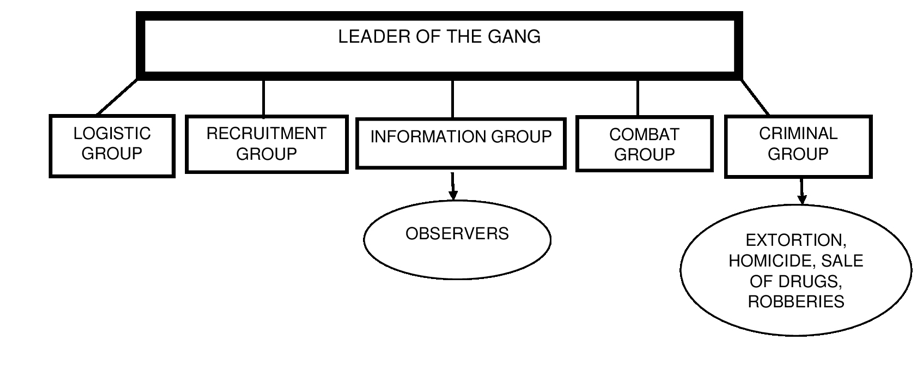
Mara Gang Structure
Source Credit: https://calhoun.nps.edu/bitstream/handle/10945/11121/bruneauMay05.pdf;sequence=3

Whether the Maras are criminals or terrorists or a hybrid of the two, governments agree they present a transnational challenge. Fueled as they are by regional social issues, the Maras are therefore very difficult to control. Dealing with the threat posed by these groups requires governments to change their perspectives in terms of strategy, security, and power. Enforcement requires police with the intelligence capacity to gather information on Mara smuggling routes, weaponry, membership, specific mechanisms for moving money, and the type of people that protect them. Intelligence sharing mechanisms with neighboring governments are paramount in order to combat cross-border crimes. Additionally, corrupt politicians that secretly support the Maras for personal gain must also be prosecuted. Though walls like the one President Trump wants to build will keep some people out of the United States, it’s exactly the wrong approach for this complex problem. Success depends instead on the creation of international partnerships, information sharing, and reduction of social anxieties that drive members into a life of crime. Mr. Trump, tear down these walls.


Ligia Lee GuandiqueLigia Lee Guandique is a political analyst living in Guatemala City, Guatemala. She holds a Bachelor’s degree in International Relations and a Master’s degree in Political Science from the Pontifical Catholic University of Chile. Ligia has worked with human rights-based NGOs and recently published this excellent piece on immigration issues.

Master of Puppets: Pulling the Strings in Turkey

On the night of July 15th 2016, Turkish Military Forces moved swiftly in the streets of both Ankara and Istanbul. What appeared to be a security operation slowly took the shape of a coup d’état as military units occupied key locations in the country’s two largest cities. Despite a history of successful coups by the Turkish military, this coup started to fail as soon as it began. Revolutionary units suffered from a lack of leadership and their seizure of critical infrastructure in and around the capital was haphazard at best. Most importantly, the coup failed to make any credible attempt to kill or capture President Recep Tayyip Erdogan, the strongman leader of the incumbent Justice and Development Party (AKP) and the lynchpin between success and failure. Despite dramatic scenes from around the country, loyalist forces were firmly back in control before sunrise and were pointing the finger of blame at a shadowy organization known by its Turkish acronym, FETÖ, the Fethullah Gülen Organization.

Erdogan’s apparent success emboldened him the following day. His security services had performed brilliantly. They were one step ahead of the coup at every turn and were already rounding up FETÖ members within the state. Despite 300 dead and more than 2100 wounded, Erdogan and AKP appeared to be in a strengthening political position and were consolidating authoritarian power across all the institutions of the Turkish government. Still, the situation remained complicated. The remaining military leadership did not have an amiable relationship with the AKP, a party whose Islamic leanings conflict with the military’s secular legacy. Erdogan the authoritarian will have to reconcile that relationship with the AKP’s devout Islamic voting base; a base that once looked to Fethullah Gülen for direction.

Stroke & Counterstroke

In 2002, Erdogan’s AKP swept the Turkish general election with an overwhelming majority. The victory was a shocking turn of events in a nation that traditionally embraced a secular order underpinned by vast military power. The secret of AKP’s success at the time was social mobilization in support of a more politically Islamic Turkey. In this endeavor, Erdogan received direct support from FETÖ media outlets and schools that enjoyed great popularity amongst Islamic voters. Though for years Erdogan benefitted politically from the relationship with FETÖ, it pitted him against the secular nationalist leadership of the military. Inspired by the secular legacy of Mustafa Kemal Ataturk, the “Kemalists” in the military were growing alarmed at the Islamization of Turkish politics led by the AKP and guided by Fethullah Gülen. Pressure mounted until 2012 when judges associated with Gülen convicted 322 military officers of plotting to overthrow the government. The failure of the plot, known locally as “Sledgehammer”, defanged the military and set its Kemalist leadership against Gülen for what the military believed was a political move against the legacy of Ataturk.

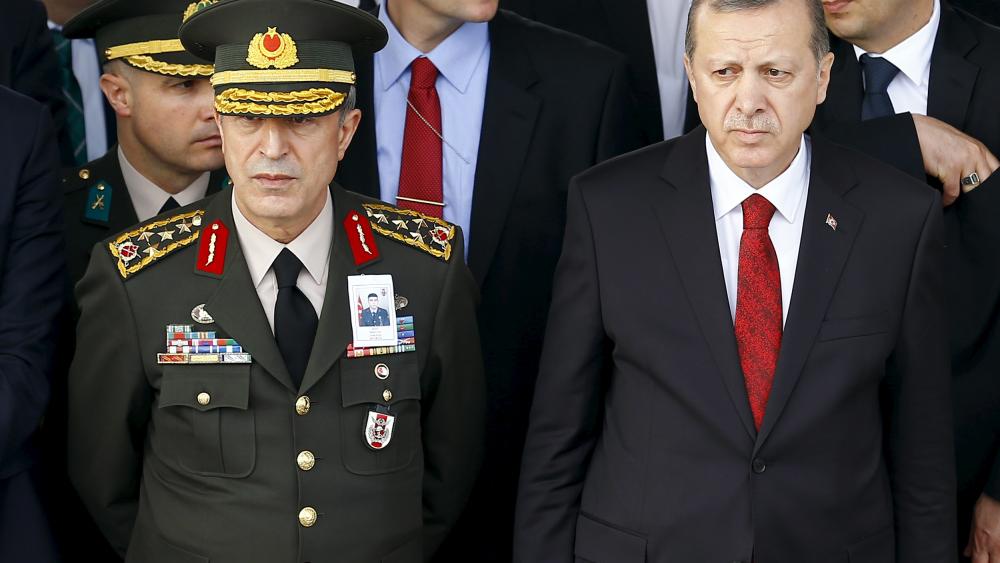
Turkey Power
The relationship between Erdogan and the military is increasingly complicated, but the coup allowed him to clean out the ranks of dissenters. Photo credit: https://www.foreignaffairs.com/articles/2016-05-30/turkeys-next-military-coup.

The relationship between the AKP and FETÖ dissolved shortly thereafter when Gülen criticized Erdogan over the handling of the 2013 Gezi Park protests; upheavals that supported freedom of the press while maligning the government for encroaching on Turkish secularism. Accusing Gülenists of running a parallel state, Erdogan expelled them from law enforcement and the judiciary. In turn, Gülen’s religiously-minded supporters viewed Erodgan’s actions as an attack on their organization and the Islamic path they sought for Turkey. Over time, as Gülen’s opposition to Erdogan’s growing power intensified, the Kemalists began to sense an opportunity to take their revenge.

Turkey Unveiled

After years of souring relations between AKP and the Gülenists, the National Security Council declared FETÖ a threat to national security in 2014; a partial victory for the Kemalists but one that did not regain them control of the military or the government. That would not happen until 2016 when Gülenists within the military sought the help of the remaining Kemalists to overthrow Erdogan and AKP. The move was not without merit. The Kemalists had already suffered at the hands of AKP and were increasingly uncomfortable with the ongoing erosion of secularism and consolidation of power by Erdogan but they calculated revenge was ultimately more beneficial than collaboration. Initially pledging their support for the coup, the Kemalists stepped aside at a critical moment, betrayed FETÖ, and declared themselves in full support of Erdogan’s government. The subsequent failure we all witnessed on television was therefore less of a success for Erdogan than it was a victory for the Kemalists. In one night, they regained control of the military and drove the wedge between AKP and its Islamic base a little deeper.

Recognizing the new reality, Erdogan changed his stripes from a one-time supporter of political Islam to an authoritarian nationalist; a position supported (for now) by the military but rejected by AKP’s traditional base. How long he can maintain this tenuous political charade will depend on his success in wielding the tools of authoritarianism; specifically, his relationship with the military and suppression of freedom of the press. The simultaneous and often conflicting vilification of FETÖ, the Kurds, and Daesh, continue to fuel police and military operations like Operation Olive Branch in Syria that serve to expand Erdogan’s power and keep his Kemalist allies busy.

Despite the outward appearance, Erdogan and AKP are without a political anchor and dangerously dependent upon the Kemalists they once betrayed. While western governments and media continue to operate on the assumption of Erdogan’s strength since the failed coup, it is likely the real master of puppets is wearing a military uniform, and he has yet to pull all his available strings.


Nuno FelixNuno Felix is a former non-commissioned officer with Portuguese Army Special Operations Forces. He is a sniper and special reconnaissance expert and is currently working as a consultant to top executives in the financial sector.
Pardon Me: Peru’s Fujimori Problem

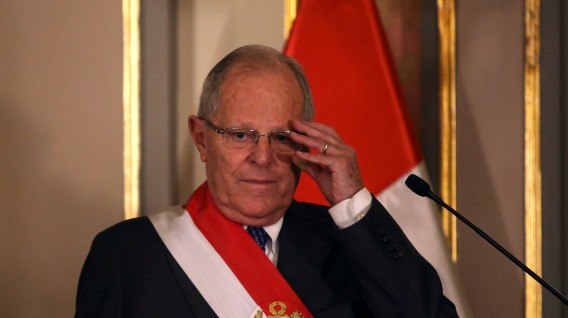
On Christmas morning 2017, protesters filled the streets of Lima, Peru in opposition to a controversial decision made by President Pedro Pablo Kuczynski (known locally as PPK). His pardon of former authoritarian President Alberto Fujimori—a deeply divisive figure in Peruvian political history—inspired the manifestations that disturbed a holiday hiatus in the characteristic buzz of the capital city. Kuczynski responded to the protests with a television address, advocating for reconciliation towards the polemic former ruler and his violent past. Kuczynski’s decision leaves the citizens of Peru struggling to reconcile the surprising influence the Fujimori family still commands in Peruvian politics and a recently elected President who campaigned, then and now, on national unity.

The 79 year-old Fujimori, who left office in 2000, was nine years into a 25-year prison sentence for corruption and human rights abuses. Citing the aging former president’s terminal heart condition and tongue cancer, Kuczynski’s Presidential Pardon Commission recommended Fujimori, along with seven other inmates, be pardoned “for humanitarian reasons.” However, such benevolence from President Kuczynski does not sit well with many Peruvians who still bear the scars of Fujimori’s violent repression. Speaking on their behalf, members of the UN Human Rights Council condemned the pardon saying, “We are appalled by this decision. It is a slap in the face for the victims and witnesses whose tireless commitment brought him (Fujimori) to justice.”

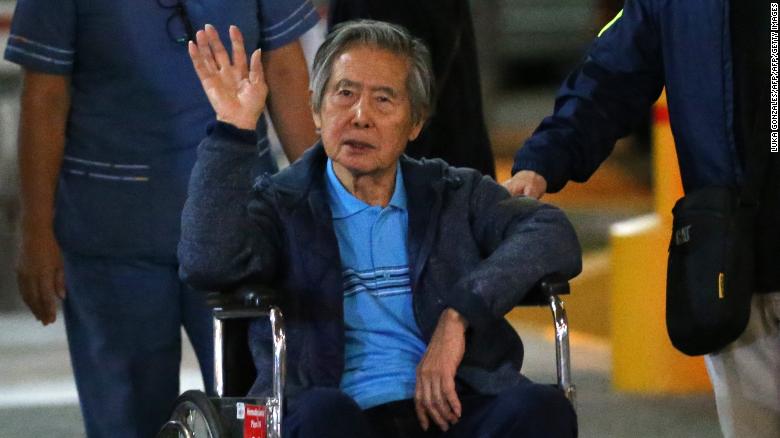
pardon
The ailing Fujimori remains a controversial figure, provoking anger, contempt, and sympathy from the Peruvian people. Photo credit: http://www.dw.com/en/alberto-fujimori-perus-ex-president-leaves-clinic-free-man-after-pardon/a-42034904

In a region with a rich history of such transgressions, the pardon of a human rights abuser is certainly controversial and President Kuczynski is in no position to take political risks. Just three days prior to granting Fujimori’s pardon, Kuczynski himself narrowly escaped impeachment on corruption charges associated with an $800 million bribery scandal involving the Brazilian construction firm Odebrecht. As a result, his approval rating is at a historic low (19% as of February 11, 2018). The pardon also forced him to reshuffle nine of his cabinet ministers into an aptly named “cabinet of reconciliation,” which he hopes will repair his party’s relationship with the Peruvian people in the coming months—an outcome easier said than done. Swelling street protests suggest Peruvians believe Kuczynski’s humanitarian impulses are a cover for what is actually a political survival deal to co-opt the powerful opposition. Obtaining a Presidential mandate in this manner has become an even greater point of civil contention than the actual pardon of Fujimori.

Sins of the Father

At the time of Fujimori’s election in 1990, Peru was in a state of national crisis. Guerilla terrorist groups were waging a violent insurgency and the economy was suffering from debilitating hyperinflation. Acting quickly and boldly, he instituted drastic measures to stabilize the economy and combat the insurgency. Under pressure and seeking to maintain his political freedom to maneuver, he staged a coup of his own government in 1992 with support from key military leaders in order to rewrite the constitution and purge his political opponents. The memory of the infamous purge elicits one of two responses from Peruvians: some demand justice for friends and loved ones that disappeared during that time, but many others welcomed the coup, viewing the government’s tactics as necessary to stabilize the country’s economy and bring an end to the terrorism.

Despite the lives Fujimori took, his children—son Kenji, a Congressman, and daughter Keiko, head of the main opposition party, Fuerza Popular—are the former president’s political legacy. But they are now a family divided. During Kuczynski’s impeachment proceedings, Kenji led a group of opposition lawmakers in abstaining from the impeachment vote, allowing Kuczynski to keep his seat long enough to enable the pardon of the elder Fujimori. This came as a blow to Kenji’s sister Keiko, that had just lost the 2016 presidential election to Kuczynski by a razor-thin 0.12% margin. In response, Fuerza Popular officially expelled Kenji and his allies, enforcing party discipline but destroying its simple-majority in Congress. Though Kenji and Kuczynski publicly deny accusations of quid pro quoReuters reported on January 26 that a back channel deal had been negotiated between them months earlier.

Pardon Me Too

Though the corruption allegations against President Kuczynski have not yet been proven, and his impeachment proceedings were politically driven, the charges against him are still troubling. Having run for President on an anti-corruption platform, he was quick to deny allegations that his private company, Westfield Capital, received any payments from Odebrecht. However, he now acknowledges Westfield was paid $780,000 between 2004 and 2006 while he served as Minister of Economy and Finance and later, Prime Minister. The shifting stories coincide with his reversal on the issue of Alberto Fujimori’s pardon and erode the credibility of his claims of innocence. Still worse, his rhetoric in response to calls for his resignation make him appear both desperate and despotic; he insists his removal from office would “disrupt political and economic stability” in Peru.

Pardon
President Kuczynski’s pardon of Fujimori puts him in a political bind, and may not save him from the next impeachment. Photo credit: https://www.thestar.com.my/news/world/2017/12/28/perus-culture-minister-resigns-after-fujimori-pardoned/

Moreover, Kuczynski boldly declared during his 2016 campaign there would be no pardon for the elder Fujimori. His righteous “unity” campaign platform narrowly won him the presidency, but nevertheless left his agenda vulnerable due to a lack of congressional support. Even in the wake of Keiko Fujimori’s presidential defeat – and before the fallout with her brother weakened her position – her Fuerza Popular opposition still held a commanding 71 of 130 congressional seats. Kuczynski’s questionable pardoning of Alberto Fujimori, be it a desperate act of self-preservation or a stroke of ambitious genius (or both), has secured Kuczynski’s presidency and weakened the opposition’s hold on Congress. Whether this was truly the result of a secret deal or just sibling rivalry, it set the stage for the next move against him. A new opposition – sans Kenji but now with some disgruntled former Kuczynski allies upset over the Fujimori pardon – has pledged a new impeachment proceeding when Congress resumes in March. Whether they have enough votes to be successful this time remains to be seen.

Last year, public polling indicated that up to 60% of the population favored pardon of Fujimori. Even after the pardon was granted, public polling indicated 50% of Peruvians still support Fujimori’s release. Presidential pardons are often controversial, but in this case the high-profile act of clemency faces international human rights scrutiny. The President that was supposed to represent stability instead wielded the pardon as a blatant tool of political manipulation—to the detriment of democracy. President Kuczynski will struggle to regain his reputation as a stabilizing political figure, and a shifting opposition will continue to maneuver against him, keeping the political focus on scandals and political controversy rather than on the much-needed and noble goal of national reconciliation. For the time being, whatever initiatives Kuczynski attempts, he will do so with the legal mandate of President of Peru, but without the pardon of the people.


The views expressed in this article are those of the author and do not reflect the official policy or position of the U.S. Air Force, the Department of Defense, or the U.S. Government.


Major John “JB” Boswell is a U.S. Air Force Intelligence Officer with deployments and operational experience in Afghanistan, South Korea, Hawaii, and Germany. He is currently a graduate student in History at the Pontifical Catholic University of Peru in Lima.

…Access, experience, and knowledge…Worldwide